Beyond the Residence: Experience-Led Living Has Found Its Next Address
Porsche Design Concours signals that experience-led living is moving from where we live to what we love — and that thoughtful building technology is no longer a differentiator. It’s the floor.
By Earnest Morgan
For the better part of a decade, branded residential has made a simple promise: live inside a brand you admire, and some of its precision, taste, and discipline will become part of your daily life. It has been a powerful idea. It has also been an incomplete one.
Because the residence was never the whole of anyone’s life. The things people care about most — the collections, the passions, the communities built around them — have mostly lived elsewhere, in spaces that have almost nothing to do with the meaning people attach to them. A climate-controlled unit off an interstate. A rented bay in a warehouse. A garage that doubles as storage for everything else.
The recent announcement of Porsche Design Concours, from Porsche Lifestyle Group and Newgard Development Group, is the clearest signal I’ve seen that experience-led living is expanding beyond the front door. And it carries a second, quieter message that anyone who designs, builds, or operates premium environments should hear clearly: the building technology that makes these places work is no longer what sets them apart. It’s what earns you the right to be considered at all.
The Garage Was Always the Tell
Harvey Hernandez, Newgard’s founder and CEO, named the problem more honestly than most developers would:
“Why do the cars we care about most often end up sitting in spaces that have almost nothing to do with the passion we have for them?”
That question is the thesis of experience-led living compressed into a sentence. For years, the industry treated storage as a commodity and passion as marketing. The wrapper got the investment — the brochure, the brand partnership, the lobby — while the substrate, the lived reality of arriving, using, sharing, and returning, was left to whatever was cheapest to build and easiest to operate.
Hernandez’s answer is equally direct: “This was never meant to be storage. It was meant to be a home for the parts of someone’s life that revolve around this passion.”
What Was Actually Announced
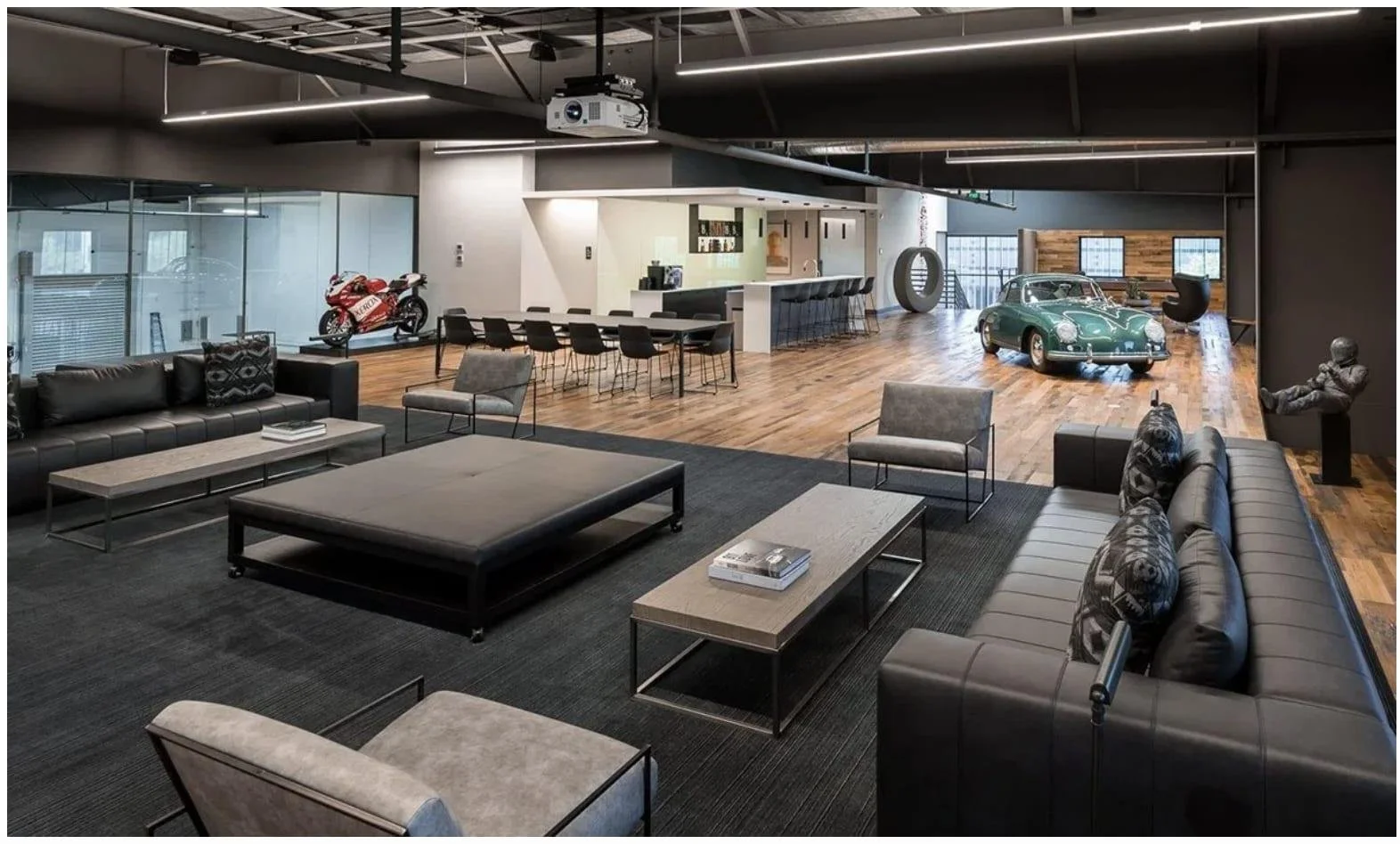
The details are worth laying out, because they tell the story. The first two destinations, in West Palm Beach and Dallas, will comprise 44 privately owned automobile studios — 22 in each city — ranging from roughly 2,700 to 6,000 square feet. Each studio carries deeded ownership, a mezzanine level, a full bathroom, a wet bar, and a climate-controlled environment engineered to protect both valuable vehicles and the comfort of the people using the space. They are conceived for an owner who might work there in the morning, rest there in the afternoon, and host friends there in the evening.
At the center of each destination sits The Concours, an interior automotive promenade that replaces the conventional exterior drive aisle with a gallery-like setting for arrival, circulation, and display. Alongside it, a private, membership-based Clubhouse — with planned amenities including padel, spa and wellness, dining, private lounges, coworking, outdoor terraces, event spaces, concierge, and 24-hour security — is designed as the social heart of the community.
Porsche ownership is not required; the concept welcomes collectors across marques, eras, and categories. Architecture and interiors were developed in close collaboration with Porsche Design and executed locally by Gensler in Dallas and Urban Robot Associates in West Palm Beach. Openings are targeted for 2028, with a broader national network planned.
One detail I’d underline twice: each destination is being sited within approximately 10 to 15 minutes of where the local collector community lives and spends its time. The intent is a place that becomes part of everyday life, not somewhere you go to retrieve a vehicle.
From Address to Affiliation
Branded residential organized experience around an address. Porsche Design Concours organizes it around an affiliation.
That is a meaningful shift. The residence answers the question “where do I live?” The clubhouse answers a harder and more valuable one: “where do I belong?” The first is bounded by square footage and a floor plan. The second is bounded only by how well the place serves the relationships people form inside it.
Several choices make this unusually clear. Opening the concept to every marque trades brand exclusivity for something more durable — a community defined by shared passion rather than a shared badge. Siting destinations inside owners’ daily radius turns an occasional errand into a routine. And pairing deeded studios with a shared clubhouse creates two layers of experience that have to work together: the private, where the owner is sovereign, and the communal, where the owner is a member.
Volker Strotmeier of the Porsche Lifestyle Group Executive Board described the project as extending Porsche Design’s philosophy “into an entirely new category.” I’d go a step further. This is experience-led living growing up — moving from a single residence to a network of places, each designed around what a person values rather than merely where they sleep.
Parity Is the Floor
Here is the part I think much of our industry still underestimates.
The customer this concept serves arrives with expectations already calibrated by the best environments in their life. Their homes are orchestrated. Their hotels anticipate them. Their cars update themselves overnight. When that person buys a deeded studio and joins a private club, they will not be impressed that the lights respond, the climate holds, the gate recognizes them, and the network works on the terrace. They will simply expect it — and they will notice, immediately and permanently, when it doesn’t.
That is what I mean when I say parity is the floor. Thoughtful building technology planning and orchestration used to be a differentiator in luxury residential and hospitality. For discerning customers, it has become the minimum expectation.
It doesn’t win the sale. Its absence loses the relationship.
Planning Is Not Orchestration
It’s worth drawing a distinction the industry often blurs.
Planning is specifying the right systems: climate, access control, network, security, charging infrastructure, lighting, audiovisual. It is necessary and technical work, and most premium projects do it competently.
Orchestration is making those systems behave as one experience. It’s the difference between a building that has good climate control and a building where you walk into your studio on an August afternoon in Dallas and find the car protected, the mezzanine cool, the lighting set for the evening you planned, and the concierge already aware your guests arrive at seven. The owner never experiences a system. They experience a moment — and the moment either feels effortless or it doesn’t.
This is why I’ve long argued that complex, high-expectation properties need a building technologist of record: someone accountable not just for whether each system was installed, but for how all of them work together over the life of the asset. Architects are accountable for form. Engineers are accountable for the performance of individual systems. Someone has to be accountable for the experience those systems produce in combination — because that is what the customer actually feels.
F. A. Porsche set out the principle when he founded Porsche Design in 1972, and the announcement rightly returns to it:
“Design is not simply art, it is elegance of function.”
— F. A. Porsche
I can’t think of a better brief for building technology. Elegance of function is what orchestration looks like when it’s done well. Nobody notices it. Everybody feels it.
The Performance Case, Stated Plainly
None of this is indulgence. When the substrate is right, the economics of an experience-led concept shift in the operator’s favor.
Dwelling time rises, because a place that works as an office, a lounge, a wellness destination, and a gallery gives people reasons to stay rather than retrieve and leave. Time to value shortens, because an owner’s first great evening in the studio happens in the first week rather than after months of punch-list frustration. The next generation of collectors — more digitally fluent and less patient with friction than any before them — gets won rather than merely tolerated. And the frontline professionals who make hospitality real, from concierge to security to club staff, become more effective when technology augments their judgment rather than replacing their presence.
Those outcomes compound. Trust builds tenure. Tenure builds community. Community builds referral velocity — and for a concept explicitly designed to grow into a national network, referral velocity isn’t a marketing metric. It’s the growth model. That is the experience dividend: the compounding return on investing in how a place actually works, not just how it looks in a rendering.
The Honest Tension
I’m genuinely excited about this concept, and I also want to be honest about where it gets hard — because the hard parts are where the real work lives. Architecture and technology age on different clocks. A deeded studio is a decades-long asset; the systems inside it will cycle many times over that span. With openings targeted for 2028, much of what is specified today will be a generation older by the time the first owner arrives. Designing for adaptability — pathways, capacity, open platforms, a real upgrade plan — matters at least as much as selecting today’s best products.
Privacy cuts the other way. The more a place anticipates its members, the more it knows about them: who is on site, when, with whom, and what sits behind their studio door. For collectors, discretion isn’t a feature; it’s a condition of trust. The orchestration has to be generous with service and disciplined with data.
Community is fragile at the seams. A club that welcomes every marque, era, and collecting philosophy has to serve very different people without flattening them into a single profile. Technology can personalize that experience, or it can standardize it into sameness.
And the hardest day isn’t opening day. It’s the ten-thousandth ordinary Tuesday after it.
Experience-led living is proven in operations — in how quickly issues surface, how clearly responsibilities are owned, and how well the people on the frontline are equipped to make things right.
Congratulations — and What Comes Next
I could not be more excited about this project, and I want to offer sincere congratulations to my friends at Porsche Lifestyle Group, and to the teams at Newgard Development Group, Gensler, and Urban Robot Associates who are bringing it to life. Taking a design philosophy that has shaped objects for more than fifty years and extending it into places where people will work, gather, and share what they love is a bold and thoughtful step.
It is also a signal to the rest of us. Experience-led living is no longer confined to where we live. It is moving into how we gather, where we belong, and the passions that organize our lives. The organizations that lead this shift will be the ones that understand the brand promise is delivered not by the rendering or the partnership, but by the machinery underneath — orchestrated so well that no one ever has to think about it.
In a world where the best experience is the one you never have to manage, thoughtful building technology isn’t the luxury. It’s the price of admission.
I’d love to hear from others working where hospitality, real estate, and technology meet: where have you seen the gap between what a place promises and how it actually works — and what finally closed it?
Earnest J. Morgan
Build the commercial engine behind an extraordinary experience. If your organization is determined to compete on customer experience — or to create experience-led living — the commercial offering and sales-excellence systems beneath it decide whether that promise becomes durable, scalable revenue.
Let’s map what that could look like for your business. Email: emorgan@navivatehome.us